

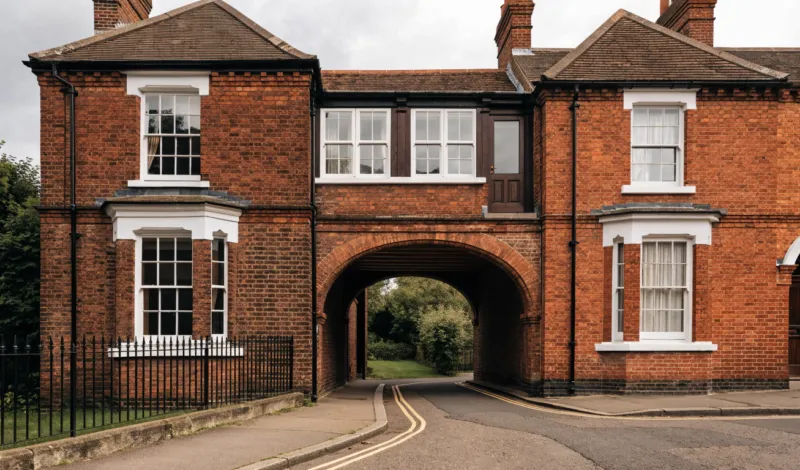

A flying freehold is part of a freehold property that sits above or below land or a structure owned by someone else. The classic example is a bedroom built over a shared passage between two terraced houses, where the room belongs to one house but the passage and the ground beneath it belong to the neighbour. Flying freeholds are common in older housing across England and Wales and are not a reason in themselves to walk away from a purchase, but they do raise legal and mortgage questions that your solicitor needs to answer before you exchange. As a firm that handles residential conveyancing for buyers of period houses in London and beyond, these are the points we look at whenever one appears on a title.
What is a flying freehold?
Freehold ownership normally runs from the ground up. A flying freehold breaks that rule: part of your property “flies” over, or sits under, land that someone else owns. Common examples include:
- a room above a covered passageway or carriage arch that leads to a neighbour’s garden or a rear yard
- a first floor bedroom that extends over part of the house next door, often the result of an old internal reconfiguration between two terraced houses
- a bay window, balcony or overhanging upper storey projecting over a neighbour’s land
- a cellar or basement that runs under the adjoining property
- in mews and coach houses, accommodation built over garages or stables that belong to a different owner
A related term is a creeping freehold, where part of your property sits below a neighbour’s, for example a cellar extending under next door. The legal issues are much the same, and lenders tend to treat them in the same way.
Flying freehold meaning: why it is a legal problem
The difficulty is not ownership itself. You can own a room that sits over someone else’s land and it will be registered as part of your title. The difficulty is what happens to the structure that holds it up, and what you can make your neighbour do about it.
Positive obligations do not bind later owners
In English law, the burden of a positive covenant, an obligation to do something such as repair a wall or maintain a roof, does not automatically pass to later owners of freehold land. The House of Lords confirmed this in Rhone v Stephens [1994] 2 AC 310, a case which itself concerned a roof that sheltered part of a neighbouring cottage. The original owner who promised to repair could be held to the promise, but a later owner could not.
For a flying freehold that is the central risk. If the passage, walls or beams beneath your room belong to your neighbour, you may have no direct way of making a future owner of that land repair them. Restrictive covenants, promises not to do something, can bind later owners, but they do not help with repair.
Support, shelter and access
Three rights matter most:
- Support: the right for your part of the building to be held up by the structure below. This can arise by grant or by implication when properties are divided, but it is better to see it expressly on the title.
- Shelter or protection: the right for the structure below or above to continue to protect your part from the weather.
- Access for repair: the right to go onto the neighbour’s land to maintain the part of your property you own. Without an express right, you may need the neighbour’s agreement or a court order under the Access to Neighbouring Land Act 1992, which is limited to works needed to preserve your property.
A right of support stops your neighbour actively removing the support, but it does not, on its own, oblige them to keep it in good repair. That gap is why the presence or absence of express repairing arrangements matters so much.
How lenders view flying freeholds
Lenders worry that a property with a flying freehold may be harder to repair, harder to insure and harder to sell. Their requirements are set out in Part 2 of the UK Finance Mortgage Lenders’ Handbook, and they vary considerably. Some lenders do not need to be told where only a small part of the property is affected. Others accept a flying freehold only up to a stated share of the floor area, with limits commonly falling between about 10% and 25%. Some decline altogether, or require indemnity insurance, or insist that enforceable rights of support, shelter and access are in place.
Because the position is lender-specific, we check your lender’s own requirements as soon as the flying freehold appears, rather than at the point of exchange. If your lender will not accept it, the earlier you know, the more options you have, whether that is a different lender, a remedial deed with the neighbour, or a renegotiation of the price.
What your solicitor will check
Flying freeholds are usually spotted from the title plan, the register or the seller’s replies to enquiries, and occasionally only from the survey. Once identified, our checks include:
- Extent. Exactly which part of the property flies or creeps, and roughly what share of the accommodation it represents. A surveyor’s input helps here.
- Rights. Whether the title includes express rights of support, shelter and access in your favour, and what rights the neighbour has over your property.
- Covenants. Whether there are any repairing covenants, who gave them, and whether there is a chain of indemnity covenants or a requirement for each new owner to enter into a direct deed.
- Condition. Whether the structure beneath or above is in good repair, and whether there is any history of disputes with the neighbour.
- Lender and insurer. Whether your lender and buildings insurer will accept the arrangement, and on what terms.
- Registration. Whether the title plan and register at HM Land Registry accurately show the flying element, since older plans can be unclear about upper floors.
All of this happens within the usual search and enquiry stage. Our guide to the stages of buying a home in England and Wales shows where it fits in the wider timetable.
| Usually lower risk | Usually higher risk |
|---|---|
| A small part of the property, such as a bay window, a sliver of a bedroom or an overhanging eave | A whole room, or a large share of the floor area, sitting over or under a neighbour’s property |
| Clear, registered rights of support, shelter and access in both directions | No express rights on the title, or rights that only run one way |
| A deed of mutual covenants that each owner must pass on to the next | No covenants at all about repairing the structure underneath |
| A neighbour who is cooperative and a structure in good repair | A neighbour who is absent, hostile, or not maintaining the part below |
| Your lender confirms the arrangement is acceptable | Your lender’s limits are exceeded, or it insists on extra conditions |
Can a flying freehold be fixed?
There is no way to remove a flying freehold without changing the physical or legal boundaries, but the risks can usually be reduced. The common approaches are:
- A deed of mutual easements and covenants with the neighbour, granting rights of support, shelter and access and setting out who repairs what, with each owner agreeing to require any buyer to enter into a fresh deed. This depends on the neighbour’s cooperation and will usually involve both sides’ solicitors and the neighbour’s lender.
- An estate rentcharge. The Rentcharges Act 1977 generally prohibits new rentcharges, but allows estate rentcharges created to make covenants enforceable or to meet the cost of services, repairs or maintenance. A nominal rentcharge can be used to make repairing covenants enforceable against later owners. It is a technical solution that needs careful drafting.
- Converting the arrangement to a lease. In some cases the parts concerned are let on a long lease, since leasehold covenants do bind successors. This is more common with flats than with houses.
- A boundary adjustment. Occasionally neighbours transfer small areas between them so that each owns from the ground up. That needs both owners, both lenders and HM Land Registry.
- Indemnity insurance. Where none of the above is realistic, a policy may cover loss in value or costs if the lack of rights causes a problem. Insurance does not create rights and lenders vary in whether they will accept it, but it can be a practical solution for a minor flying element.
In 2011 the Law Commission recommended a new type of interest, the “land obligation”, which would allow positive obligations to bind later freehold owners. That recommendation has not been implemented, and the current leasehold and commonhold reforms do not change the position for freehold houses with flying elements.
Should you buy a property with a flying freehold?
Often, yes. Plenty of period houses with flying freeholds are bought, mortgaged and sold without difficulty. The right question is whether this particular arrangement is acceptable to you, your lender and future buyers. In practice the deciding factors are the size of the flying element, whether the title contains proper rights and repairing arrangements, the condition of the structure, and your relationship with the neighbour.
A small overhang with good rights and a cooperative neighbour is rarely a concern. A whole room above a passage owned by an absent neighbour, with no repairing arrangements and a lender at the limit of its policy, is a different matter and may justify a price reduction or a remedial deed before exchange.
Flying freeholds are particularly common in London’s mews houses, converted coach houses and terraces that have been altered over 150 years. If you are buying at the upper end of the market, our guide to buying a £1m+ home in London covers the other title and planning checks that matter alongside this one.
Flying freeholds and leasehold houses
Some houses with flying elements are leasehold rather than freehold, which can make repair arrangements easier because leasehold covenants bind successors. If you own a leasehold house and are thinking of acquiring the freehold, it is worth considering how any flying or creeping parts will be dealt with in the transfer. Our guide to buying the freehold of a leasehold house explains that process.
If a dispute arises with your neighbour
Where a neighbour refuses access for urgent repairs, or lets the structure beneath your property deteriorate, the first step is usually a clear written request setting out the rights you rely on. If that fails, there are court routes, including an access order under the Access to Neighbouring Land Act 1992 and claims based on any rights or covenants that do bind the neighbour. Our property litigation team can advise on the options and on resolving matters without proceedings where possible.
Frequently asked questions
Can you get a mortgage on a house with a flying freehold?
Usually, yes, but it depends on the lender. Some lenders accept a small flying freehold without conditions, others limit the share of the floor area affected, and some require indemnity insurance or proper rights of support, shelter and access, or decline altogether. Your solicitor should check your lender’s requirements as soon as the flying freehold is identified.
Are freehold flats difficult to sell?
Often, for the same reason flying freeholds raise questions: the burden of a positive covenant, such as an obligation to repair the structure beneath, does not automatically bind later owners of freehold land. Many lenders therefore will not lend on a freehold flat, which narrows the market. Most flats are sold on long leases instead, because leasehold covenants do bind later owners.
What does freehold mean when buying land?
Owning the freehold means you own the land and any buildings on it outright, with no time limit and no landlord. Ownership normally runs from the ground up, which is what makes a flying freehold unusual: part of the building sits above or below land owned by someone else. The extent of what you own is shown on the title plan and register at HM Land Registry.
Talk to us
A flying freehold is a question to resolve, not a reason to panic. The earlier it is identified, the easier it is to check the rights, confirm the lender’s position and, if necessary, put things right before you are committed. If you are buying a property with a flying freehold and want it looked at properly, our residential conveyancing team can help. Call us on +44 207 566 1188 or email info@gurvelegal.com.

